Foreword
IMSCI 2015 was organized and sponsored by the International Institute of Informatics and Systemics (IIIS, www.iiis.org), member of the International Federation of Systems Research (IFSR). The IIIS is a multi-disciplinary organization for inter-disciplinary communication and integration , which includes about 4500 members. Consequently, a main purpose of the IIIS is to foster knowledge integration processes, interdisciplinary communication, and integration of academic activities. Based on 1) the transdisciplinarity of the systemic approach and its emphasis on relationships and integrating processes, and 2) the multi-disciplinary support of cybernetics’ and informatics’ concepts, notions, theories, technologies, and tools, the IIIS has been organizing multi-disciplinary conferences as a platform for fostering inter-disciplinary communication and knowledge integration processes.
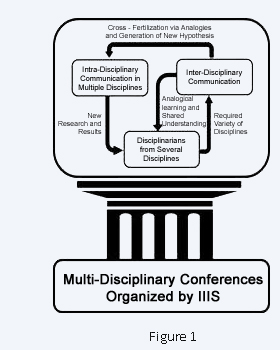
Multi-disciplinary conferences are organized by the IIIS as support for both intra- and inter-disciplinary communication. Processes of intra-disciplinary communication are mainly achieved via traditional paper presentations in corresponding disciplines, while conversational sessions, regarding trans- and inter-disciplinary topics, are among the means used for inter-disciplinary communication. Intra- and inter-disciplinary communications might generate co-regulative cybernetic loops, via negative feedback, and synergic relationships, via positive feedback loops, in which both kinds of communications could increase their respective effectiveness. Figure 1 shows at least two cybernetic loops if intra- and inter-disciplinary are adequately related. A necessary condition for the effectiveness of Inter-disciplinary communication is an adequate level of variety regarding the participating disciplines. Analogical thinking and learning processes of disciplinarians depend on it; which in turn are potential sources of the creative tension required for cross-fertilization among disciplines and the generations of new hypothesis. An extended presentation regarding this issue can be found at www.iiis.org/MainPupose. |
 |
One of the main purposes of IMSCI 2015 is to bring together academics, professionals, and managers from the private and the public sectors, in order to share ideas, results of research, and innovative services or products, in a multi-disciplinary and multi-sector forum.
Educational technologies, socio-economic organizations, and socio-political processes are essential domains among those involved in the evolving co-adaptation and co-transformation between societies and cultures on the one hand, and between informatics and cybernetics (communication and control) on the other hand. Consequently, the main conference in the context of the IMSCI 2015 Multi-Conference is the 13th International Conference on Education and Information Systems, Technologies and Applications: EISTA 2015
The relationship between education/training and Information and Communication Technologies (ICT) is quickly intensifying and sometimes appears in unexpected forms and in combination with original ideas, innovative tools, methodologies, and synergies. Accordingly, the primary purpose of EISTA 2015 has been to bring together researchers and practitioners from both areas together to support the emerging bridge between education/training and the ICT communities
In the context of EISTA 2015, practitioners and consultants were invited to present case studies and innovative solutions. Corporations were invited to present education/training information systems and software-based solutions. Teachers and professors were invited to present case studies, specifically developed information systems, and innovative ideas and designs. Educational scientists and technologists were invited to present research or position papers on the impact and the future possibilities of ICT in educational systems, training processes, and methodologies. Managers of educational organizations and training consultants were invited to present problems that might be solved by ICT or solutions that might be improved by different approaches and designs in ICT.
EISTA 2015 provides a forum for the presentation of solutions and problems in the application of ICT in the fields of education/training. Authors of the papers included in the proceedings provided diverse answers to the following questions:
- What is the impact of ICT in education and training?
- How are ICTs affecting and improving education and training? What networks and models are emerging?
- How are universities, schools, corporations and other educational/training organizations making use of ICT?
- What electronic tools are there to facilitate e-learning, distance education and co-operative training?
On behalf of the Organizing Committees, I extend our heartfelt thanks to:
-
the 80 members of the Program Committees (including the events and the special tracks organized in the context of IMSCI 2015) from 24 countries;
-
2. The 245 additional reviewers, from 57 countries, for their double-blind peer reviews; and
-
The 111 reviewers, from 29 countries, for their efforts in making the non-blind peer reviews. (Some reviewers supported both: non-blind and double-blind reviewing for different submissions)
A total of 722 reviews made by 356 reviewers (who made at least one review) contributed to the quality achieved in IMSCI 2015. This means an average of 7.29 reviews per submission (99 submissions were received). Each registered author had access, via the conference web site, to the reviews that recommended the acceptance of their respective submissions. Each registered author could also get information about: 1) the average of the reviewers evaluations according to 8 criteria, and the average of a global evaluation of his/her submission; and 2) the comments and the constructive feedback made by the reviewers, who recommended the acceptance of his/her submission, so the author would be able to improve the final version of the paper.
In the organizational process of IMSCI 2015, about 99 articles were submitted. These pre-conference proceedings include about 50 papers, from 17 countries that were accepted for presentation (53 countries taking into account the presentations in collocated events). We extend our thanks to co-chairs special tracks organizers for their support. The submissions were reviewed as carefully as time permitted; it is expected that most of them will appear in a more polished and complete form in scientific journals.
This information about IMSCI 2015 is summarized in the following table, along with the other collocated conferences:
Conference |
# of submissions received |
# of reviewers that made at least one review |
# of reviews made |
Average of reviews per reviewer |
Average of reviews per submission |
# of papers included in the proceedings |
% of submissions included in the proceedings |
WMSCI 2015 |
229 |
837 |
1332 |
1.58 |
5.82 |
150 |
65.50% |
IMSCI 2015 |
99 |
356 |
722 |
2.03 |
7.29 |
50 |
50.51% |
CISCI 2015 |
143 |
571 |
1243 |
2.18 |
8.69 |
79 |
55.24% |
TOTAL |
471 |
1772 |
3297 |
1.86 |
7.00 |
279 |
59.24% |
We extend our gratitude to the co-editors of these proceedings for the hard work, energy and eagerness they shown preparing their respective sessions. We express our intense gratitude to Professor William Lesso (1931-2015) for his wise and opportune tutoring, for his eternal energy, integrity, and continuous support and advice, as the Program Committee Chair of past conferences, and as Honorary President of WMSCI 2015, as well as for being a very caring old friend and intellectual father to many of us. We also extend our gratitude to Professor Belkis Sánchez, who brilliantly managed the organizing process.
We also express our immense gratitude to Professors Friedrich Welsch, Jorge Baralt, Angel Oropeza, José Ferrer, Andrés Tremante, and José Vicente Carrasquero for chairing or co-chairing the respective Program Committees and/or Organizing Committees.
We also extend our gratitude to the following scholars, researchers, and professionals who accepted to deliver plenary workshops and/or to address the audience of the General Joint Plenary Sessions with keynote conferences.
Plenary Workshops,more details (abstracts and short bios) were included in the Conference Program booklet and at http://www.iiis.org/summer2015plenaryevents/
Professor Emeritus Stuart Umpleby, The George Washington University, USA, Former President of The American Society of Cybernetics.
Plenary Keynote Speakers, more details (abstracts and short bios) were included in the Conference Program booklet and at http://www.iiis.org/summer2015plenaryevents/
Professor Leonid Perlovsky, Northeastern University, USA, Previously Visiting Scholar at Harvard, University, USA and Principal Research, Scientist at The Air Force Research Laboratory
Professor Shigehiro Hashimoto, Kogakuin University, Japan, Associate to the President and Dean of Admissions Center, Doctor of Engineering and Doctor of Medicine Biomedical Engineering
Dr. Jeremy Horne, President-emeritus, Southwest Area Division, American Association for the Advancement of Science (AAAS), USA
Dr. Karl H. Müller, Director of The Steinbeis Transfer Center New Cybernetics, Vienna, Austria and Professor at the University of Ljubljana, Slovenia
Professor Thomas Marlowe, Seton Hall University, USA, Department of Mathematics and Computer Science, Program Advisor for Computer Science, Doctor in Computer Science and Doctor in Mathematics
Dr. Ronald Styron, University of South Alabama, USA, Director of the Quality Enhancement Plan
Dr. Robert Cherinka, MITRE Corporation, USA, Senior Principal Information Systems Engineer
Mr. Joseph Prezzama, Associate Department Head for the MITRE Corporation’s Tampa Operations Office
Dr. Marta Szabo White, Georgia State University, USA, Associate Professor, Strategic Management, Director of the Robinson College of Business Honors Program, Director of Study Abroad Programs: Transition Economies and Business Mediterranean Style
Dr. Russell Jay Hendel, Towson University, USA, Dept of Mathematics
Dr. Jennifer Styron, University of South Alabama, USA, College of Nursing, Former Research Specialist and Distance Education Coordinator at The University of Southern Mississippi, USA
Mr. Tom Hull, Florida Polytechnic University, USA, Vice President and Chief Information Officer
Professor Wolfgang G. Stock, University of Düsseldorf, Germany, Chair - Head of the Information Science Department
Dr. Mario Lamanna, Evoelectronics, Italy and Selex-SI, USA, Senior Scientist
Dr. Houman A. Sadri, University of Central Florida, USA, Political Science Department, Founder and President of the Information & Policy Analysis Center (IPAC)
Dr. Madelyn Flammia, University of Central Florida, USA, Associate Professor in International Technical Communications, Vice President, International Policy and Analysis Center
Dr. Tilia Stingl De Vasconcelos, Academia Nova, Austria, University of Applied Sciences, Dresden - Study Center Vienna, Information Management, Cross Cultural Communication
Professor Ulrich Schmitt, University of Stellenbosch, South Africa Business School, Former IT consultant in London and Basle and professor and vice president at two independent universities in Germany
Professor Osmo Kivinen, University of Turku, Finland, Director of the Research Unit for the Sociology of Education (RUSE)
Lecturer Juha Hedma, University of Turku, Finland, For 20 years, researcher at the Research Unit for the Sociology of Education (RUSE)
Professor Ya-Huei Wang, Chung Shan Medical University, Taiwan, Research interest: adaptive learning, interdisciplinary cooperative learning, complementary learning, etc.
Professor José I. Peláez, Universidad de Málaga, Spain, Director de la Cátedra de Métricas y Gestión de Intangibles, Premio Spinoff en Creación de Empresas de base tecnológica, en el campo del marketing digital.
Dr. Alvaro Turriago Hoyos, Universidad de la Sabana, Colombia
Professor Gabriela Vilanova, Universidad Nacional de la Patagonia Austral, Argentina, Directora de Proyectos de investigación en el área Ingeniería de Software
Professor Jorge Varas, Universidad Nacional de la Patagonia Austral, Argentina, Co-Director de Proyectos de investigación en el área Ergonomía Organizacional aplicada a las Pymes regionales.
Professor Andres Tremante, Florida International University, USA, The
Mechanical & Materials Engineering (MME) Department
Many thanks to Drs. Dale Zinn, Sushil Archarya, Esther Zaretsky and professors Michael Savoie, Jorge Baralt, Hsing-Wei Chu, Mohammad Siddique, Andrés Tremante, Friedrich Welsch, Thierry Lefevre, José Vicente Carrasquero, Angel Oropeza, for chairing and supporting the organization of conferences and/or special tracks in the context of, or collocated with, IMSCI 2015. We also wish to thank all the authors for the quality of their papers, and the Program Committee members and the additional reviewers for their time and their contributions in the respective reviewing processes.
Our gratefulness is also extended to the organizations that provided scientific, academic, professional, or corporative co-sponsorships. The following are among these organizations:

Special Thanks to Dr. Jeremy Horne, Dr. Harvey Hyman, and Ms. Molly Youngblood Geiger (Google Partners Community Ambassador) for their efforts in helping us with the identification of above shown co-sponsors.
We extend our gratitude as well to María Sánchez, Juan Manuel Pineda, Dalia Sánchez, Bebzabeth García, Marcela Briceño, Kiesten Loewenthad, and Freddy Callaos for their knowledgeable effort in supporting the organizational process producing the hard copy and CD versions of the proceedings, developing and maintaining the software supporting the interactions of the authors with the reviewing process and the Organizing Committee, as well as for their support in the help desk and in the promotional process.
Professor Andrés Tremante, and
Professor Nagib Callaos (www.iiis.org/Nagib-Callaos )
IMSCI 2015 General Co-Chairs
