

Main Purpose of the IIIS
The International Institute of Informatics and Systemics (IIIS) is a multi-disciplinary organization for inter-disciplinary communication and integration. Consequently, a main purpose of the IIIS is to foster knowledge integration processes, interdisciplinary communication, and integration of academic Activities. Based on 1) the trandisciplinarity of the systemic approach along with its essential characteristic of emphasizing relationships and integrating processes, and 2) on the multi-disciplinary support of cybernetics’ and informatics’ concepts, notions, theories, technologies, and tools, the IIIS has been organizing multi-disciplinary conferences as a platform for fostering inter-disciplinary communication and knowledge integration processes.
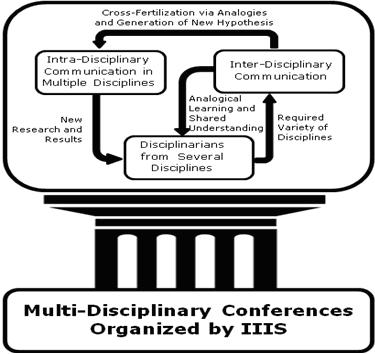 Multi-disciplinary
conferences are organized by the IIIS as support for both intra- and inter-disciplinary
communication. Processes of intra-disciplinary communication are mainly achieved
via traditional paper presentations in corresponding disciplines, while conversational
sessions, regarding trans- and inter-disciplinary topics, are among the means used
for inter-disciplinary communication. Intra- and inter-disciplinary
communications might generate co-regulative cybernetic loops, via negative
feedback, and synergic relationships, via positive feedback loops, in which
both kinds of communications could increase their respective effectiveness. Figure
1 shows at least two cybernetic loops if intra- and inter-disciplinary are adequately
related. A necessary condition for the effectiveness of Inter-disciplinary communication
is an adequate level of variety regarding the participating disciplines.
Analogical thinking and learning processes of disciplinarians depend on
it; which in turn are potential sources of the creative tension required for cross-fertilization
among disciplines and the generations of new hypothesis. An extended presentation
regarding this issue can be found at
https://www.iiis.org/MainPurpose
Multi-disciplinary
conferences are organized by the IIIS as support for both intra- and inter-disciplinary
communication. Processes of intra-disciplinary communication are mainly achieved
via traditional paper presentations in corresponding disciplines, while conversational
sessions, regarding trans- and inter-disciplinary topics, are among the means used
for inter-disciplinary communication. Intra- and inter-disciplinary
communications might generate co-regulative cybernetic loops, via negative
feedback, and synergic relationships, via positive feedback loops, in which
both kinds of communications could increase their respective effectiveness. Figure
1 shows at least two cybernetic loops if intra- and inter-disciplinary are adequately
related. A necessary condition for the effectiveness of Inter-disciplinary communication
is an adequate level of variety regarding the participating disciplines.
Analogical thinking and learning processes of disciplinarians depend on
it; which in turn are potential sources of the creative tension required for cross-fertilization
among disciplines and the generations of new hypothesis. An extended presentation
regarding this issue can be found at
https://www.iiis.org/MainPurpose
Intra- and Inter-Disciplinary Presentations at IIIS conferences
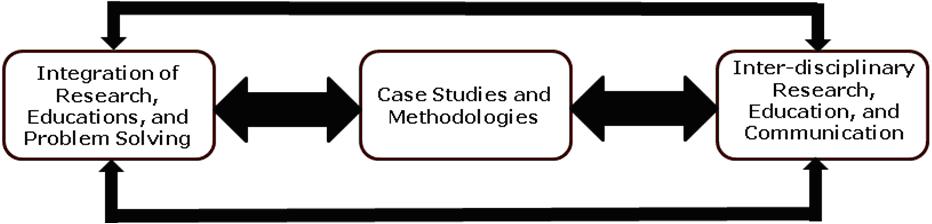
The multi-disciplinary conferences organized by the IIIS include intra-disciplinary presentations in different disciplines and inter-disciplinary communication via formal presentations, informal conversational sessions, and hybrid ones. Frequently, the IIIS allows authors of disciplinary presentations to make additional presentation, with no additional cost, in order to foster inter-disciplinary communication which might generate the fertile analogies, working hypothesis, and inter-disciplinary research and real life problem solving. More on the meaning and importance of “interdisciplinary communication” can be found at https://www.iiis.org/Nagib-Callaos/Interdisciplinary-communication. The IIIS is also trying to foster conference presentations in 1) Inter-disciplinary Research, Education, and problem solving, 2) in Academic Activities Integration, and 3) in inter-, cross-, and trans-disciplinary areas like Case Studies and Methodologies, Design, Modeling, Simulation, Systemics, Cybernetics, Informatics, Expansion of Science, Knowledge Generation, Communication, and Management, etc.
Currently three complementary events, related to interdisciplinary communication and knowledge integration are part of what is common to the three conferences being yearly organized by the IIIS. Figure 2 schematize the three events and the relationships among them.

Contact Us